Introduction
Why Discipleship Can’t Wait
“Go therefore and make disciples of all nations, baptizing them in the name of the Father and of the Son and of the Holy Spirit, teaching them to observe all that I have commanded you. And behold, I am with you always, to the end of the age.” (Matthew 28:19-20)
We Have an Emergency
Imagine a hospital where only one percent of the medical staff believes the patients are actually getting better.
That is not a sobering data point. That is a crisis.
That is where we find ourselves in the Church today.
We have an emergency.
According to Barna reporting from work with The Navigators on the state of discipleship, less than one percent of senior pastors and discipleship pastors said that today’s churches are doing “very well” at discipling new and young believers. Six in ten said that churches are discipling “not too well.” Taken together, that is not reassurance from pastors who preach and plan for spiritual growth week after week. Very few rated our collective disciple-making as thriving; many rated it as struggling.
The numbers do not improve from there. Only 4 percent of American adults now hold a consistent, Scripture-rooted biblical worldview—a framework for understanding God, sin, salvation, truth, and the purpose of life that actually holds together and shapes how they live. That number has been falling for thirty years. We claim faith in enormous numbers. We live it out in very small ones.
Among practicing Christians, only 17 percent regularly meet with a spiritual mentor. That means eight in ten believers are trying to grow in Christ entirely alone—with no one walking alongside them, asking honest questions, and pointing them back to the Word.
When we ask younger believers where becoming spiritually mature ranks among their life priorities, we hear the answer plainly. For millennials who identify as evangelical Christians, it falls at number six—behind finishing their education, starting a career, becoming financially independent, following their dreams, and figuring out who they are. For Gen Z evangelicals, it has slipped to number nine.
Let that land. We are talking about people who attend evangelical churches. People who identify as followers of Jesus Christ. And spiritual maturity does not crack the top five.
We should feel the weight of that. Not shame—nobody benefits from being buried in guilt. But we cannot fix a problem we will not face. The data is not the problem; it is the mirror. And the mirror is showing us something we need to see.
We have an emergency. And emergencies demand a response.
The Quiet Diagnosis
How did we get here?
Walk with me into a fairly typical Sunday morning. The room fills. There is music, and it is genuinely good. There is a sermon, and most of it is solid. People exchange hellos in the lobby. Someone asks, “How are you doing?” and the answer is, “Oh, fine—things are going great.” Then everyone drives home.
We repeat this the next week. And the week after that.
Meanwhile, behind the fine exteriors, people are struggling. A marriage is fracturing. Faith is wobbling under hard circumstances. Someone has not prayed in weeks and does not know how to say it out loud. A teenager is drifting from everything their parents tried to instill. But the masks stay on, because Sunday morning is not a safe place to drop them.
This is not a criticism of any particular church. It is a description of a drift that has happened almost everywhere, almost imperceptibly, over a generation or two. We have built a remarkably consumer-shaped church culture. We come for an hour. We receive. We leave. It is tidy and mostly painless.
But when Jesus sent His people out with the Great Commission, He was not describing a managed exchange between a provider and a recipient. He was describing transformation—the kind that slowly, persistently conforms us to the image of His Son. That does not happen in a lobby. It happens in a relationship. One on one. No masks. Iron sharpening iron (Proverbs 27:17).
There is a second layer to the diagnosis, and it is harder to name. Some of the people sitting in our churches have never genuinely come to faith. Somewhere they made a decision—walked an aisle, prayed a prayer—but the Holy Spirit was never resident in them, and the life change that marks authentic conversion never followed. Without the Spirit, no program in the world will produce the fruit we are looking for. The gospel must come first. Real conversion is the starting point, not a box we tick.
But for those who have genuinely come to faith? The second cause is equally common: someone treated their conversion as a finish line instead of a starting line. They were brought to Christ and then left there. No one came alongside them. No one said, “Welcome—now let me show you what this life looks like.” The beginning of discipleship was mistaken for the end of it.
These two realities account for much of what the surveys keep finding. The worldview is thin because the faith is thin—and the faith is thin because no one is walking anyone toward depth. Somewhere along the way, many of our churches allowed discipleship to become optional.
It is not optional. Jesus commanded it.
Two Questions That Never Go Away
Here is what I have found after more than forty years of walking alongside believers in ministry.
In every church, in every context, in every generation, two questions keep rising to the surface among people who are serious about following Jesus.
First: How do we bring people to Christ? Not how do we attract larger crowds, or how do we make our gatherings feel more accessible—but how do we faithfully speak the gospel to someone who does not yet know Jesus? How do we go from knowing a neighbor to praying for that neighbor, to being present enough and trusted enough to have a real conversation about eternity?
Second: How do we actually grow? Not how do we stay productive for God, or how do we add another study to an already crowded calendar—but how do we become people whose lives are genuinely beginning to look like Jesus? How does Sunday morning become Monday morning? How does truth in the head become love in the hands?
These two questions belong together, because they answer one command: “Go and make disciples of all nations… teaching them to observe all that I have commanded you” (Matthew 28:19-20). Jesus did not hand His Church one task called evangelism and another called discipleship. Making disciples begins the day someone first hears the gospel and continues until that person is walking in obedience to Christ. Bringing people to Christ is where it starts. Leading them to maturity in Christ is how it continues.
We need both. Bringing without growing produces converts who do not know what they have been saved into. Growing without bringing produces a church that is getting more polished in a room by itself while the world around it drifts further from God. The Great Commission never separated them. Neither does this book.
“If It’s New, It Probably Ain’t True”
It helps to say plainly what this book is not.
It is not a new model for discipleship. I am not proposing a clever framework that requires the Church to set aside two thousand years of faithful practice and start over. There is a saying that has proven wise in matters of faith: “If it’s new, it probably ain’t true.” We should be deeply cautious—frankly, suspicious—of any approach to Christian living that treats novelty as a virtue.
The Ancient of Days has not been silent. He has spoken clearly and completely. “All Scripture is breathed out by God and profitable for teaching, for reproof, for correction, and for training in righteousness, that the man of God may be complete, equipped for every good work” (2 Timothy 3:16-17). We are not here to supplement what God has already said. We are here to pay closer attention to it.
I am not an inventor, nor do I call myself an author. I am more like an editor, trying to peer intently into the pure Word of God, and faithfully let others know what it says.
I have spent more than forty years in discipleship ministry—walking alongside people in the military, in churches, across generations, sitting across coffee tables and kitchen tables from believers who were trying to figure out how to follow Jesus and how to help others do the same. And over those years, one question kept pressing on me. When Jesus said “teaching them to observe everything I have commanded you” (Matthew 28:20), what did He mean by everything?
That word matters. Not some things. Not the parts that are easy or popular. Everything.
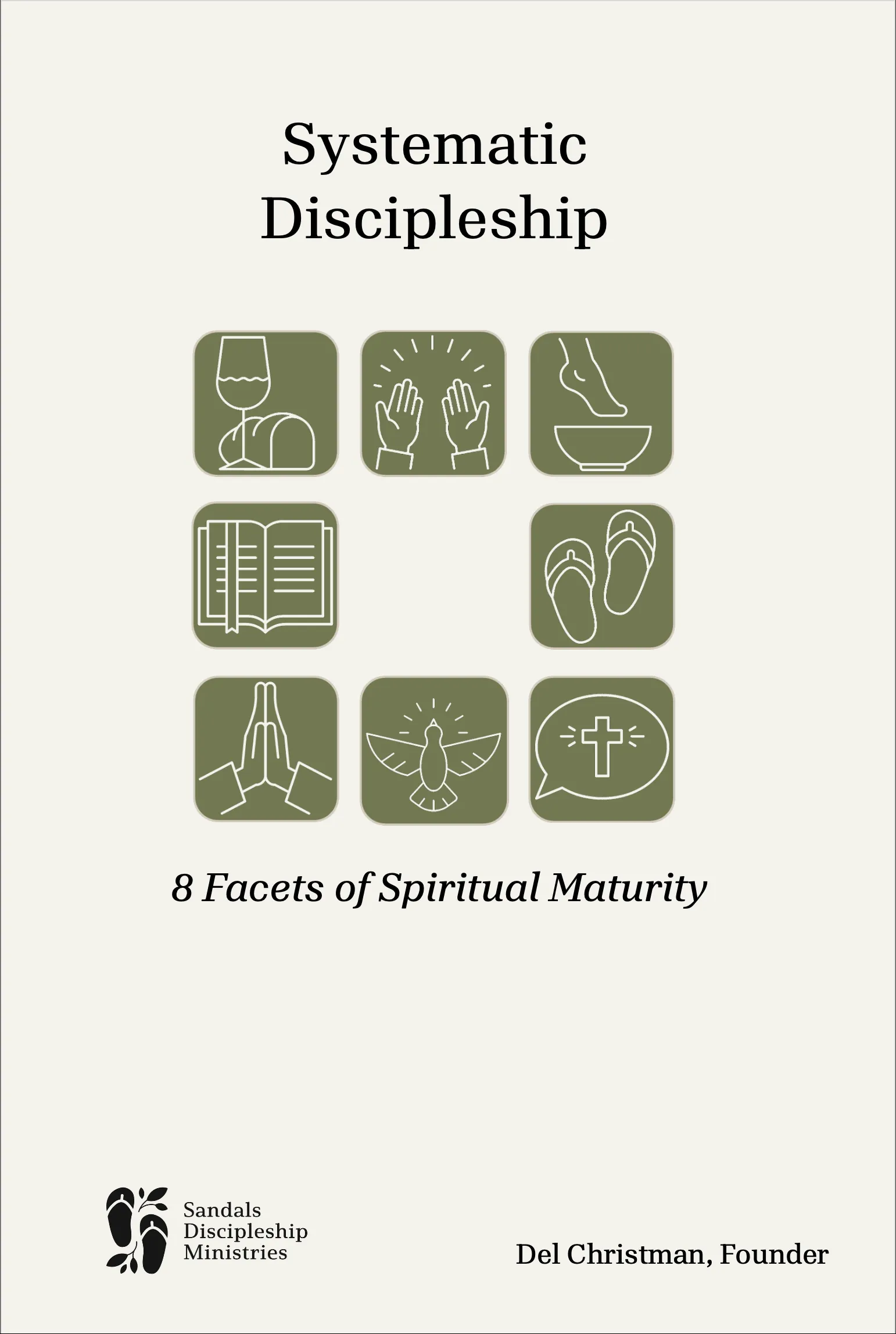
So I went back to the Scriptures. Specifically, I spent long hours in Acts 2—the earliest snapshot of the Church, the first believers who had heard the Great Commission and were actually living it out day by day. In those few verses that describe their life together (Acts 2:4, 42-47), eight distinct areas of growth emerge. Not as a list that someone cleverly constructed, but as a pattern that Scripture itself displays. Eight facets of what it looks like to grow in every way more and more like Christ—which is, in the plain language of Ephesians 4:15, exactly what we are called to do.
And to verify that these eight covered the fullness of Scripture’s call, I went further—through every passage of the Gospels—and found that every one of them maps to one of these eight. This is not my taxonomy. This is Scripture’s own shape of spiritual maturity. I am simply describing what was already there.
That weight of discovery did not feel like something to carry alone—nor, frankly, should it have. I reached out to like-minded brothers and sisters who shared the same burden, and together we formed Sandals Discipleship Ministries. From this point forward, you will notice the voice in these pages shift from “I” to “we”—and that shift is deliberate. The challenge of biblical discipleship is not a solo assignment. It belongs to the whole body of Christ. Whatever is true and useful in this work has been sharpened, corrected, and brought to life by men and women who hold one another—and themselves—accountable to what God has actually said in His Word and requires of us in obedience. None of it has come from one person’s insight. It has come from Him, worked out through His people together. We do not use “we” to obscure personal responsibility; we use it because the Christian life, and certainly the discipleship life, is never lived alone. The Spirit moves through community. The Word is tested in relationship. And the Great Commission is carried by the whole Church.
The ministry name, Sandals itself, is intentional. In Mark 6, when Jesus sent His disciples out two by two to do the work of the kingdom, He told them to take almost nothing for the journey—except sandals and a staff. The sandals are where the commission meets the road. They are a daily reminder that this faith was meant to be walked out, not just studied. And the name is a reminder that what we are describing in this book is not a weekend event or a course you complete. It is a walk. A daily, relational, unhurried, long-haul walk with Jesus and with one another.
So no—none of this is new. But in many of our churches and in many of our lives, it has been forgotten. This book is an attempt to return to the ancient paths.
“Thus says the Lord: ‘Stand by the roads, and look, and ask for the ancient paths, where the good way is; and walk in it, and find rest for your souls.’” (Jeremiah 6:16)
A Map for the Journey
The eight facets of spiritual maturity are not a checklist. They are a map. A checklist records your failures; a map shows you where you actually stand and points you toward where you can go. We need the map.
The eight facets grow directly out of the two great commandments—love God with everything you have, and love your neighbor as yourself (Matthew 22:37-39). They organize like this: Worship God is our highest aim—the first and constant response of a redeemed heart to the glory of God. Live by the Spirit is the undergirding reality—the only power by which any of the other facets become possible. “Apart from me you can do nothing,” Jesus said plainly (John 15:5). Three facets express our love for God: Know Christ, Obey the Word, and Pray Continuously. Three facets express our love for those made in His image: Be Holy, Serve One Another, and Bear Witness.
All eight. In every way. More and more like Christ.
This is not a new invention. It is the path Jesus set before us—the same one His first disciples walked, the same one the Church has stumbled back to in every era of genuine renewal.
Here is how the book walks through it.
In Part I—Biblical Foundations for a Life of Discipleship, we ask the foundational questions: What is the gospel we actually proclaim? What did Jesus’ call to “follow me” really mean to those who first heard it—and what should it mean to us? How do we actually change? These three chapters establish the theological floor beneath everything else.
In Part II—Why We Don’t Disciple, we name the gap between what we believe and how we live. We look honestly at the research, at the fears and hesitations that keep believers from stepping into discipleship relationships, and at the pastoral invitation every local church must extend—not as a new program, but as a culture of genuine care and intentional growth.
In Part III—The Systematic Approach, we introduce the eight facets in full and walk through what it means to read Scripture through the lens of spiritual maturity. We present the Spiritual Maturity Landscape, a self-assessment tool that maps your perceived strengths and gaps across all eight facets. Then we set out the two things that make this approach concrete and relational: growth objectives—focused, Scripture-based lessons tied to each facet—and the discipleship pair, a more mature believer walking intentionally alongside a newer one.
In Part IV—Bringing People to Christ, we follow the Bear Witness pathway: a four-step, practical, repeatable approach to sharing the gospel in the normal flow of everyday life. Pray by name for the lost. Turn ordinary conversations toward eternal things. Share your story. Share His story. These four steps are not a formula to memorize. They are a faithful rhythm that any believer—any believer—can follow.
In Part V—Growing in Christ, we return to each of the eight facets in depth, with stories, with Scripture, and with the growth objectives that make each facet concrete and actionable. This is the heart of the book—practical, biblically grounded, Spirit-dependent growth in every dimension of the Christian life.
In Part VI—Cultivating a Discipleship Culture, we ask the bigger question: how does this move from a personal practice to the fabric of a whole community? How does it reach from the discipleship pair to the small group to the eldership to the church-wide culture? And how do we keep at it for the long haul, when the urgency fades and the old patterns try to creep back in?
Each chapter closes with reflection questions and a suggested practice for the week—because knowing is not enough. The New Testament is blunt about this: “Be doers of the word, and not hearers only” (James 1:22). This book is built for doers.
A Word Before We Begin
There is a tree in Psalm 1 that I keep returning to.
“Blessed is the one… whose delight is in the law of the Lord, and who meditates on his law day and night. That person is like a tree planted by streams of water, which yields its fruit in season and whose leaf does not wither. Whatever they do prospers” (Psalm 1:1-3).
That tree does not produce fruit by straining harder. It does not stay green by trying more. It bears fruit and stays rooted because of where it is planted—close to the water, roots going deep, nourished by what is always flowing beneath the surface.
Discipleship—real, biblical, relational discipleship—is the invitation to plant yourself near those streams. To plant others near them too. To let the Word of God, the Spirit of God, and the people of God do together what God designed them to do.
This is not a new approach. It is the biblical way. The Ancient of Days set it in motion long before any of us arrived, and He has been calling His people back to it in every generation.
We have an emergency. But we also have a Book that does not fail, a Spirit that does not tire, and a Savior who said, “Behold, I am with you always, to the end of the age” (Matthew 28:20).
That is more than enough.
Let’s go.